

.avif)


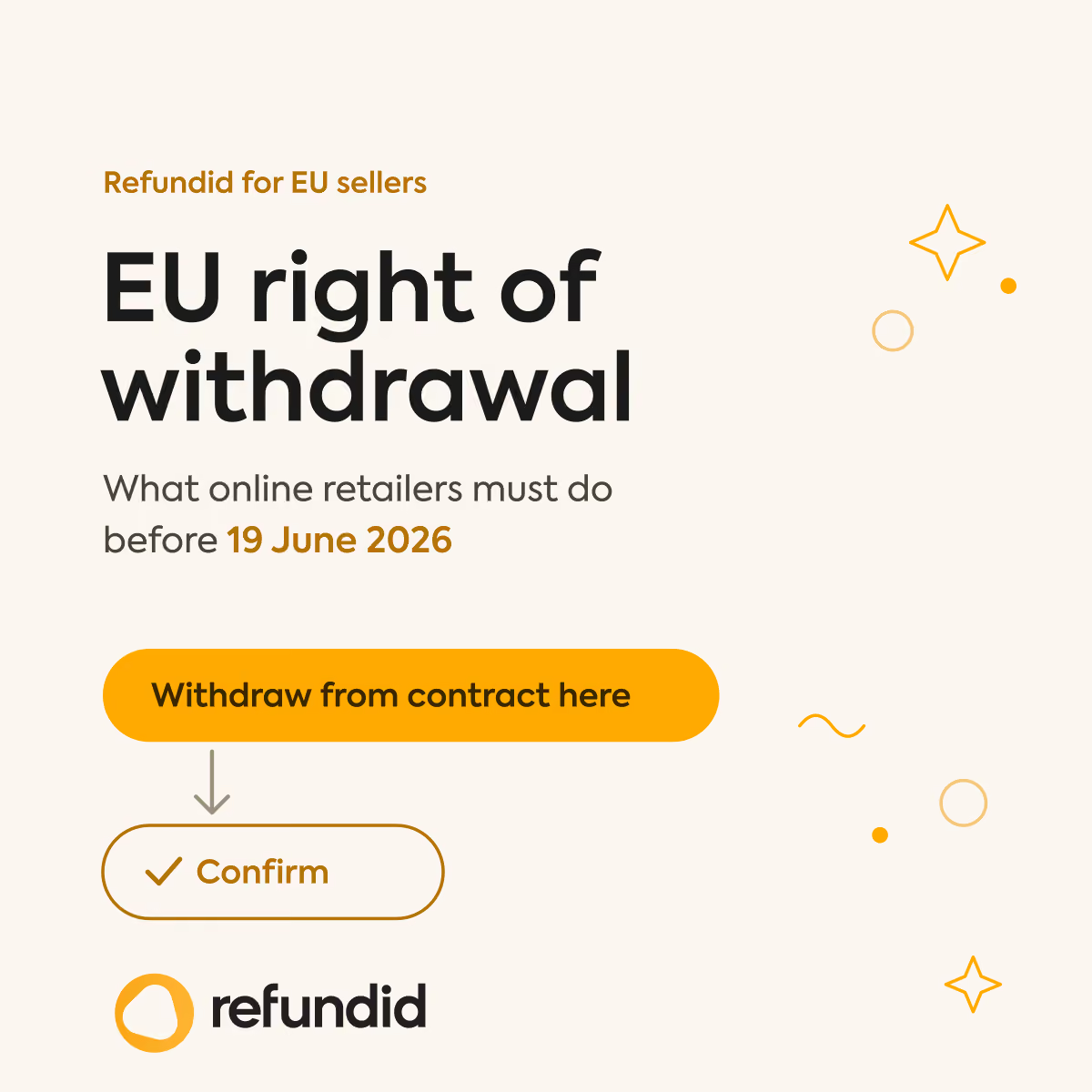


If you sell to customers in the EU, you have until 19 June 2026 to add a working "withdrawal button" to your store. There's a lot of noise about this right now, and a fair bit of it is wrong. So before the fixes and the sales pitches, here's what's actually happening.
What's actually changing (and what isn't)
The right of withdrawal itself is not new. EU shoppers have had a 14-day cooling-off period on online purchases for over a decade, under the Consumer Rights Directive. They can cancel an eligible order within 14 days of receiving it, no reason needed, and get their money back. None of that is moving.
What's new is how customers exercise that right. From 19 June 2026, an amendment to the directive (Directive (EU) 2023/2673) requires a dedicated withdrawal function on your store: a clearly labelled button that lets a customer start a cancellation in a couple of clicks, available for the whole 14-day window, with a confirmation step and a written confirmation back to them.
That's the change. A button and a confirmation. Worth getting right, but smaller than some of the panic suggests.
It's not the Digital Fairness Act
You'll see posts blaming this on the Digital Fairness Act or "one-click cancellation." Ignore those. The Digital Fairness Act is a proposal that may apply somewhere around 2029. It is not law, and it is not what lands in June. If a vendor is selling you something "because the Digital Fairness Act requires it now," they haven't read the rule. The dated, real requirement is the withdrawal-button amendment to the Consumer Rights Directive.
Does this apply to you?
Probably, if any of your customers are in the EU. The rule binds any trader selling to EU consumers online, wherever the business is based. An Australian or UK store shipping into the EU is in scope just as much as one in Berlin. It also isn't tied to one platform. Whatever your store runs on, the obligation is the same, even if the way you implement it differs.
Why your returns page doesn't count
This is the part stores get caught on. A withdrawal is a legal act that cancels the contract. A return is the logistics that follow. The two aren't the same, and the regulators have been clear that a generic "Returns" or "Contact us" page does not satisfy the new rule.
A compliant withdrawal function has to be its own thing:
- A button labelled as a withdrawal, not buried in your returns policy
- Reachable without making the customer log in or jump through hoops
- A two-step flow: the customer submits the withdrawal, then confirms it
- A confirmation back to the customer on a durable medium (an email works), with the date and time recorded
What happens if you skip it
The headline most posts lead with is the fine. Penalties are set by each EU member state, and for cross-border breaches they can reach up to 4% of your annual turnover in the markets concerned. Real, but it varies.
The risk that applies to everyone is quieter and arguably worse: if you don't provide and explain the withdrawal option properly, the customer's cancellation window can stretch from 14 days to 12 months. That's a year of any eligible order being cancellable. Most retailers would rather spend an afternoon on a button.
What a compliant flow actually needs
Pulling it together, you need a way for an EU customer to:
- Find and click a clearly labelled withdrawal button on your store, any time in the 14-day window
- Confirm the withdrawal in a second step
- Receive a timestamped confirmation that it's a withdrawal, on a durable medium
- Get their refund, including the original outbound delivery cost they paid
- Have the whole thing recorded, so you can show you complied if anyone asks
Point 4 trips people up. On a withdrawal you have to refund the original outbound shipping the customer paid (up to your standard delivery rate), not just the items. Return postage is a separate question, and the customer usually covers that.
How Refundid handles it
We built this as an extension of the returns product you already know, so it isn't a separate system to learn. Turning it on takes about five minutes, and for your customer it's a three-click flow.
Here's what it does:
- Gives you a dedicated withdrawal URL, separate from your normal returns portal, for EU customers
- Captures the customer and order details the law requires, and skips the return-reason step, because a withdrawal needs no reason
- Sends an automatic confirmation on a durable medium so the customer has proof it's a withdrawal
- Issues the refund for the items and the original outbound shipping once you approve, whether you approve on receipt or while the parcel is in transit
- Generates the return label so the customer can send the goods back
- Keeps the records and audit trail, so the bookkeeping side of compliance is handled
Existing Refundid retailers have already switched it on. With the deadline close, that matters.
The withdrawal flow sits alongside your Refundid returns portal, so there's nothing extra for your team to run. If you're not on Refundid yet, book a demo and we'll show you how it works.
FAQ
When is the EU withdrawal button mandatory?
19 June 2026.
Is this the Digital Fairness Act?
No. It's an amendment to the Consumer Rights Directive (Directive (EU) 2023/2673). The Digital Fairness Act is a separate proposal that isn't law yet.
I'm outside the EU. Am I affected?
If you sell to EU consumers, yes, regardless of where your business is based.
Can I just use my returns page?
No. The withdrawal function has to be a distinct, clearly labelled button with a confirm step and a durable-medium confirmation.
Do I have to refund shipping?
You refund the original outbound delivery the customer paid, up to your cheapest standard delivery option. Return postage is usually the customer's cost.
What's the penalty for getting it wrong?
Fines vary by member state and can reach 4% of annual turnover for cross-border breaches, and the cancellation window can extend to 12 months per order.