

.avif)




TL;DR
Australian Consumer Law doesn't set a number of days for processing a refund. For change of mind returns, the timeframe and the form of refund are whatever your policy says, and you have to stick to it. For faulty products the customer can be entitled to a refund under the consumer guarantees. That refund should be the full amount and go back the way they paid, unless they agree to something else, so you can't make store credit the only option for faulty goods. Store credit is fine for change of mind returns if you say so upfront. If you issue it as a gift card, check the gift card rules on expiry.
This post builds on our guide to change of mind refund laws in Australia.
How long do you have to process a refund?
The ACL doesn't give a deadline in days. Where the ACCC talks about timing for faulty products, it uses "a reasonable time", which depends on the product and the problem. For change of mind returns, the timeframe comes from your own policy.
That makes the number in your policy the one that matters. Once you publish "refunds within 5 business days", customers will expect it, and the ACCC is clear that a business with a change of mind policy has to follow it. Pick a number you can hit in your busiest month, not your quietest.
Be precise about when the clock starts, too. "Within 5 business days" could mean from when the customer lodges the return, when the carrier scans the parcel, when it reaches your warehouse or when your team approves it, and those dates can be more than a week apart. Say which one you mean, and mention that banks and card providers can take a few extra days to show the money.
Faulty products
With a faulty product, what matters is how quickly you assess the claim and deliver the remedy. If a minor problem isn't fixed within a reasonable time, the customer can ask for a refund or replacement instead, or get it fixed elsewhere at your cost. Sitting on a faulty claim can turn a cheap repair into a full refund.
What form the refund has to take
When a customer is owed a refund for a major failure, the ACCC says it should be the full amount they paid, with nothing taken off for use, and in the same form as the original payment unless you both agree otherwise. So a card payment goes back to the card.
The ACCC's own example is a hotel booking. If the guest paid by credit card, the hotel can't refund them in loyalty points unless the guest chooses that. If they paid with points, the hotel can refund the points. For an online store that means the part of an order paid by card goes back to the card, and by the same logic, the part paid with a gift card can generally go back as gift card credit.
When you can give store credit instead of a refund
That depends on why the item is coming back.
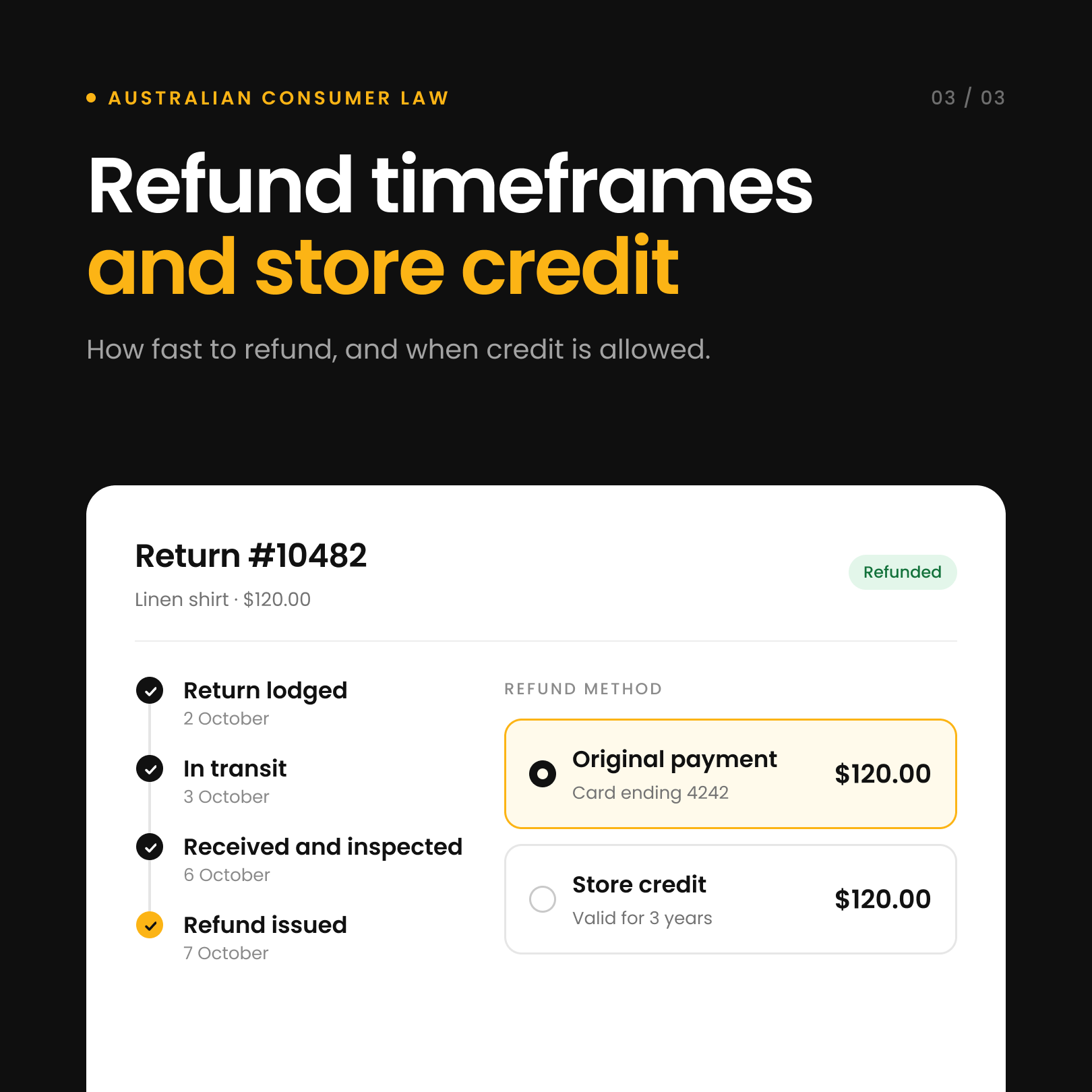
For change of mind returns you can offer store credit only, an exchange only, a refund, or let the customer pick. Customers have no legal right to any of these, so it's your offer to make. Say what it is before they buy, and apply it the same way to everyone.
For a product with a major failure, the customer chooses a refund or a replacement. You can offer store credit as well, but you can't make it the only option. Policies that say "exchange or credit note only" on sale items are a common way to get this wrong, because they read as though they apply to faulty sale items too.
For a minor failure, you choose between repair, replacement and refund. Store credit isn't one of those three, so if you want to offer it, the customer has to agree.
Do store credit and credit notes have to last three years?
Gift cards bought on or after 1 November 2019 have to be redeemable for at least three years. The expiry date has to be displayed prominently, and you can't charge fees after purchase, like activation or inactivity fees. The ACCC's guidance on gift cards is written about cards customers buy, and it lists exceptions such as loyalty program rewards and promotional giveaways. It doesn't deal specifically with credit issued when a customer returns something.
A lot of stores issue return credit as a gift card through their ecommerce platform anyway, so the simplest approach is to treat it like one. Make it valid for at least three years, or don't give it an expiry at all, and show the expiry clearly on the credit and in your policy. Customers should know what they're getting before they send the item back.
Exchanges
Exchanges split the same way. For change of mind, offering an exchange instead of a refund is your choice. For a major failure, a replacement of the same type of product is one of the customer's two options, so it's fine if that's what they ask for. Swapping a faulty item for something different, like another style, isn't the remedy the law gives them, so it needs their agreement.
Our guide to faulty vs change of mind returns covers how to tell a major failure from a minor one.
Getting refunds out faster with Refundid
Most of the wait in a refund is the return trip: the parcel travelling back, sitting in a queue, then waiting to be inspected. With Refundid's instant refunds, eligible customers get their money when they lodge the return, before they've sent the item back. Refundid funds the refund upfront and your team still inspects the item and approves or declines it under your policy. If the item isn't returned or you decline it, Refundid carries that risk.
For returns that go through the standard process, the returns portal handles refunds, store credit and exchanges, and you can show or hide each option depending on the return reason. You can keep change of mind returns to store credit or an exchange while faulty returns can still choose a refund. Customers can check where their return is up to in the portal or the Refundid app, so fewer of them email asking where their money is. Book a demo to see how it would work with your policy.
Related reading
- Change of mind refund laws in Australia: what retailers need to know
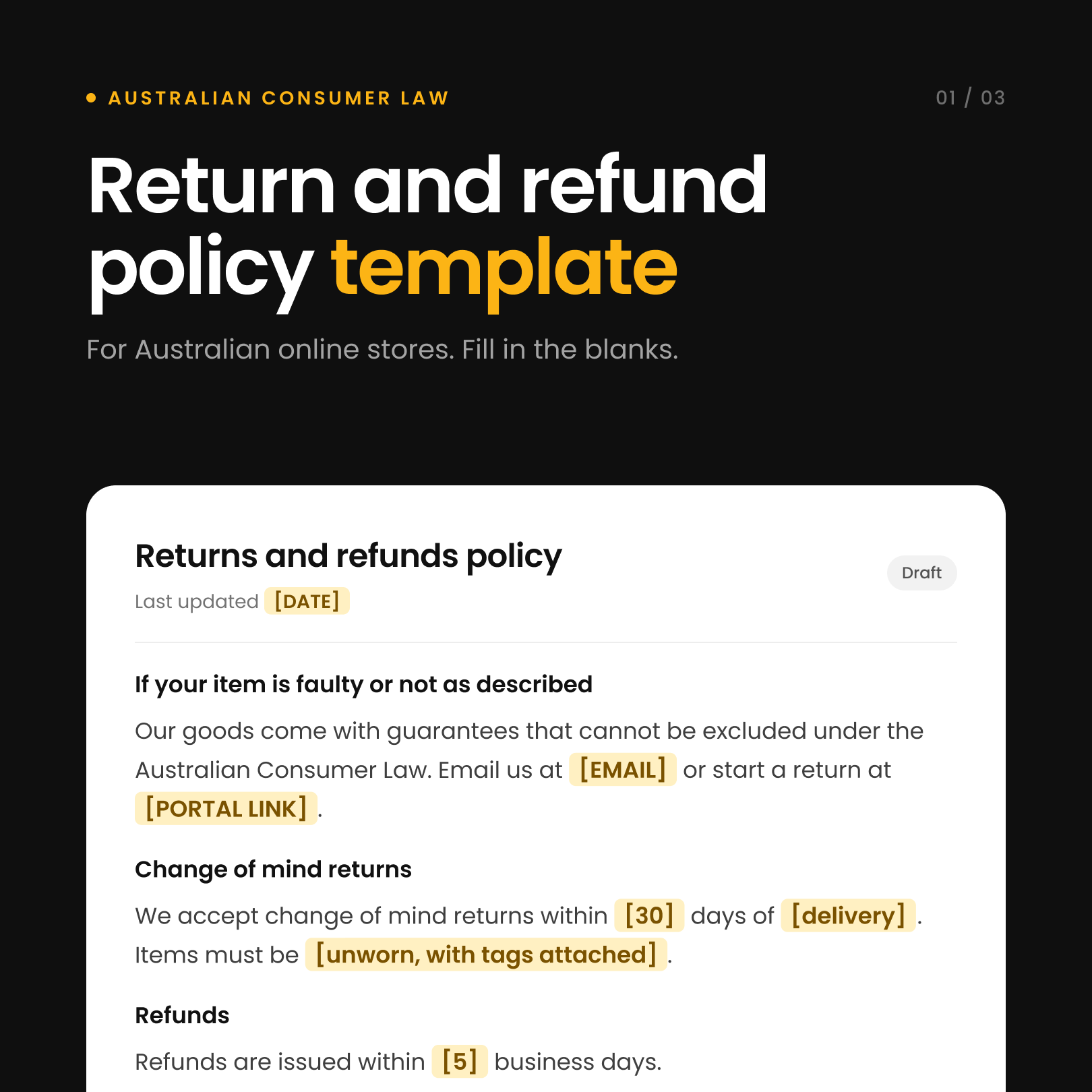
- Return and refund policy template for Australian online stores
- Faulty vs change of mind returns: what Australian retailers must do
This is general information only and should not be considered legal advice. If you're not sure how the law applies to your business, talk to a lawyer.