







Key takeaways
- Reverse logistics is everything that happens to an order after the customer decides to send it back, from the return request to the item's final destination.
- Every returned item ends up restocked, discounted, refurbished, sent back to a supplier, liquidated, broken down for parts or recycled, and each of those recovers less of its value than the one before.
- Time is the cost most stores miss, because an item sitting in a parcel or a receiving queue keeps losing value until it's back on sale.
Most online stores spend years tuning the path from warehouse to customer. The path back gets far less attention, even though every return has to travel it, and the money a store gets back depends on how well it's run.
This guide covers what reverse logistics means for an ecommerce business, the stages a return goes through, and what happens to returned stock at the end.
What is reverse logistics?
Reverse logistics is the movement of goods from the customer back to the business, and everything done with them once they arrive. Forward logistics gets an order to the customer. Reverse logistics handles what comes back.
For an online store, most of that is customer returns. It also covers parcels that couldn't be delivered or were refused, warranty claims and repairs, product recalls, and unsold stock going back to a supplier.
Ecommerce leans on reverse logistics more than physical retail does. A shopper in a store can try something on before paying. An online shopper can only find out at home, so more of what's sold online comes back, and it arrives as a stream of single parcels in every possible condition.
Reverse logistics vs returns management
The two terms overlap, and people often use them to mean the same thing. A useful way to split them is that returns management is the customer-facing side: the policy, the return request, the refund or exchange, and the communication in between. Reverse logistics is the physical side: moving the item, receiving it, checking it and deciding where it goes.
A store needs both to work together. A fast refund doesn't help much if the item then sits in a warehouse for a month. We cover the customer-facing side in what is returns management.
The stages of reverse logistics in ecommerce
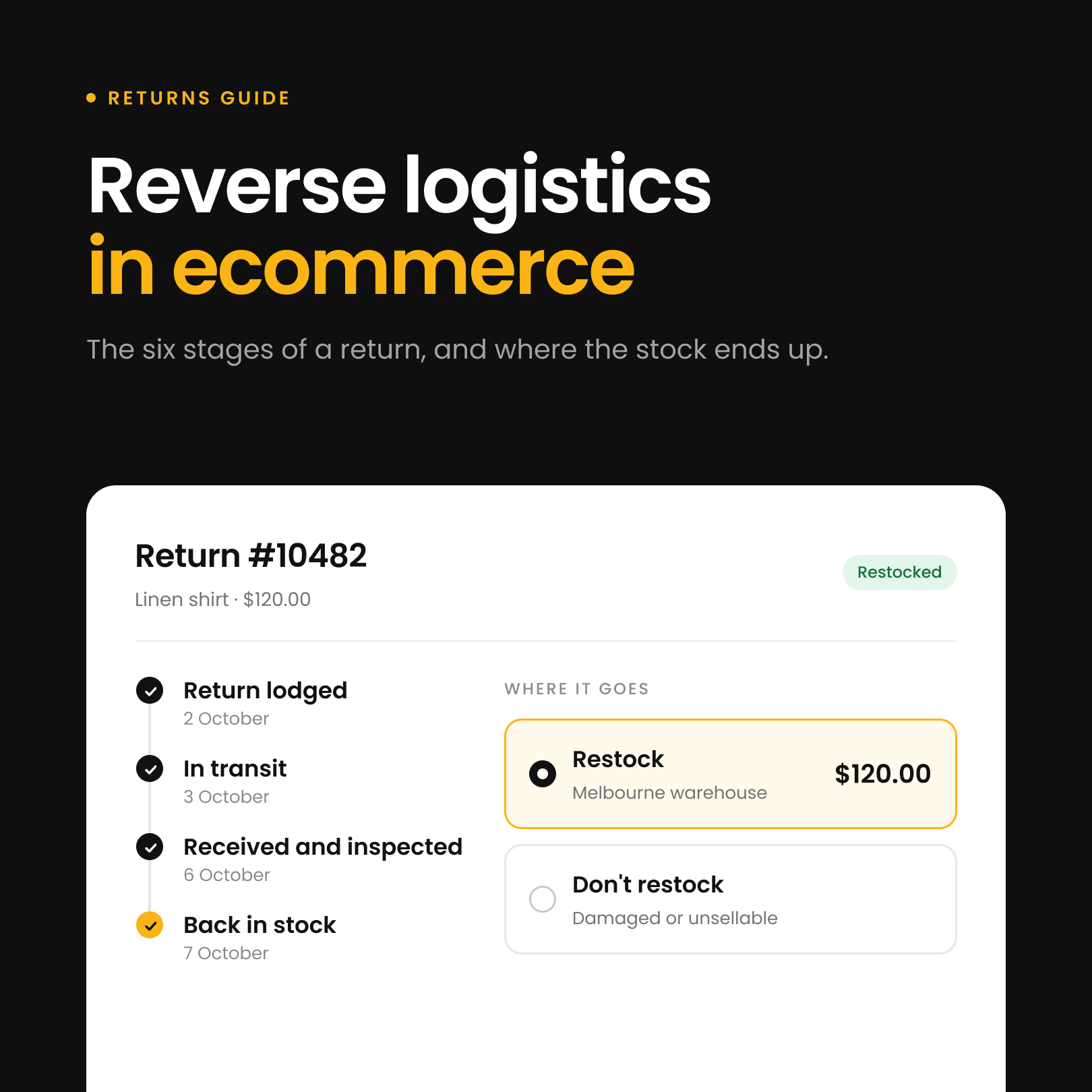
The details vary by store and by carrier, but most ecommerce returns move through the same six stages.
1. The return request
It starts when a customer asks to send something back. The store checks the order is inside the return window, records which items are coming back and why, and issues a return authorisation, often called an RMA. The return reason collected here matters later, because it's the first clue to what condition the item will arrive in. Our post on return reasons goes into how to collect them so they're useful.
2. Getting the item back
Next, the customer needs a way to send the item. That's usually a prepaid return label, but it can also be a drop-off point, a carrier pickup or a return to a physical store. If you sell on Shopify, we've written about how to create a Shopify return label.
3. Transit and tracking
Once the parcel is moving, tracking tells both sides where it is. The customer knows their return is on the way, and the store knows what's about to arrive and can plan for it. Some stores also use tracking to approve a return as soon as the parcel is scanned, rather than waiting for it to land. We cover this in more detail in real-time tracking for ecommerce returns.
4. Receiving and inspection
When the item arrives, someone opens it, matches it to the return and checks its condition. Is it unworn with the tags on? Opened but fine? Damaged, used or missing parts? Is it even the item that was ordered? The answer decides what the item is worth and where it goes next. This is also where most return fraud gets caught, from swapped items to empty boxes, which we cover in return fraud and returns abuse.
5. Disposition
Disposition is the decision about where the item ends up. It's the stage that has the biggest effect on how much money comes back, so it gets its own section below.
6. Closing the return
The last step is settling up with the customer: a refund, an exchange or store credit. Some stores do this only after inspection. Others refund or ship the exchange earlier and settle any problems afterwards. Either way, the return is closed and the stock records are updated so the item can be sold again if it's going back on the shelf.
What happens to returned items
Every returned item has to go somewhere. These are the usual options, roughly in order from the most value recovered to the least.
- Restock and sell as new. The item is unused, in its original packaging and goes straight back into stock at full price.
- Sell at a discount. It's fine to use but no longer new, so it's sold as open box, seconds or in a sale.
- Repair or refurbish. It needs work before it can be sold, like cleaning, replacing a part or repackaging.
- Return to the supplier. Faulty or unsold items go back to the brand or manufacturer under a returns agreement.
- Liquidate. Stock that won't sell through your own channels goes to a third party, usually in bulk and at a steep discount.
- Harvest parts. The product is taken apart and the working parts are sold or used in repairs.
- Recycle, donate or dispose. Nothing can be resold, so the item is recycled, given away or thrown out.
The gap between the top and bottom of that list is large. An item that goes back on sale as new recovers most of its price. One that ends up recycled recovers close to nothing. Most of what a store can do to protect margin on returns comes down to keeping items as near the top of the list as possible.
Why time matters in reverse logistics
The longer an item takes to come back and be processed, the further down that list it tends to slide. Clothing goes out of season, a new model replaces the old one, or the next sale marks the price down anyway. A swimsuit that comes back in March either waits until summer for a buyer or gets discounted to move now. Even an item in perfect condition can lose part of its value just by sitting in a parcel or a receiving queue.
That makes speed one of the main costs in reverse logistics, even though it never shows up as a line item. We go through ways to shorten that delay in how to reduce return processing costs.
Common reverse logistics challenges for online stores
Returns are harder to plan for than outbound orders. Outbound stock moves in predictable batches. Returns come back one parcel at a time, on the customer's schedule, and you don't know their condition until you open them.
Volume swings make it worse. Returns peak after big sale periods and the holidays, exactly when warehouse teams are already stretched. Small parcels from all over the country cost more per item to ship than bulk freight. And every return needs a person to look at it, which is hard to automate.
Then there's visibility. If returns are handled in emails and spreadsheets, it's hard to know what's coming back, what condition it's in or why it was returned in the first place. Without that, it's hard to fix the products and listings that cause returns.
Where returns software fits
Returns software handles the parts of reverse logistics that involve the customer and the data. It takes the return request, applies your policy, issues the label or drop-off instructions, tracks the parcel and settles the refund or exchange. Your warehouse or 3PL still handles the physical side. The software makes sure they know what's coming and why.
Refundid is a returns platform for online stores. Customers lodge returns through a self-service portal and get a label or drop-off option straight away, and they're reminded to send the item if they haven't yet. You can approve returns automatically from the parcel's tracking status. When you close a return, you choose which items go back into stock and at which location. With instant refunds and instant exchanges, customers can get their money or replacement before the original item arrives, and Refundid carries the risk if it never comes back.
If you're comparing tools, our roundup of Shopify returns apps covers the main options. To see how Refundid would work for your store, book a demo.
Reverse logistics FAQ
What is an example of reverse logistics?
A customer orders a jacket online, finds it's too small and lodges a return. They print a prepaid label and drop the parcel off. The store receives it, checks it's unworn with the tags on, puts it back into stock and refunds the customer. Each of those steps is part of reverse logistics.
What are the 5 R's of reverse logistics?
The lists vary, but a common version is returns, reselling, repairs, repackaging and recycling. Longer versions add steps like recalls, refurbishing and reuse. They're all ways of describing the same idea: getting the item back, then recovering as much value from it as you can.
Is reverse logistics the same as returns management?
They overlap. Returns management usually means the customer-facing process, like the policy, return request and refund. Reverse logistics usually means the physical side, like shipping, inspecting and restocking. Most stores need both working together.
Who handles reverse logistics for an online store?
Usually a mix. The store sets the policy and makes the disposition decisions. A carrier or shipping provider moves the parcel. A warehouse or 3PL receives and inspects the item. Returns software connects them so each one knows what's happening.


