






Key takeaways
- A restocking fee is the part of a refund a store keeps when an item comes back, usually a percentage of the price, and most stores that charge one set it between 10% and 25%.
- Restocking fees are generally legal in the US and on change of mind returns in Australia, but the fee has to be disclosed before purchase and can't be applied to faulty items.
- Exchanges, store credit and shopper-paid return cover at checkout recover some of the cost of returns without taking money off the customer's refund.
Most shoppers only meet a restocking fee when their refund comes back smaller than they expected. For a retailer it's a pricing decision: how much of the cost of a return you pass on to the customer, and what that does to the next sale.
Below is how the fee is worked out, the rates stores usually charge, where the law in the US and Australia draws the line, and what you can offer instead.
What is a restocking fee?
A restocking fee is an amount a store keeps from a customer's refund when they return an item. It's meant to cover the cost of taking the item back into stock: receiving it, checking it over, repackaging it and, in some cases, selling it for less because it's no longer new.
It's normally a percentage of the item's price, so a pricier item carries a bigger fee. Some stores charge a fixed amount per item instead. Either way, the customer doesn't pay it upfront. It comes off the money they get back.
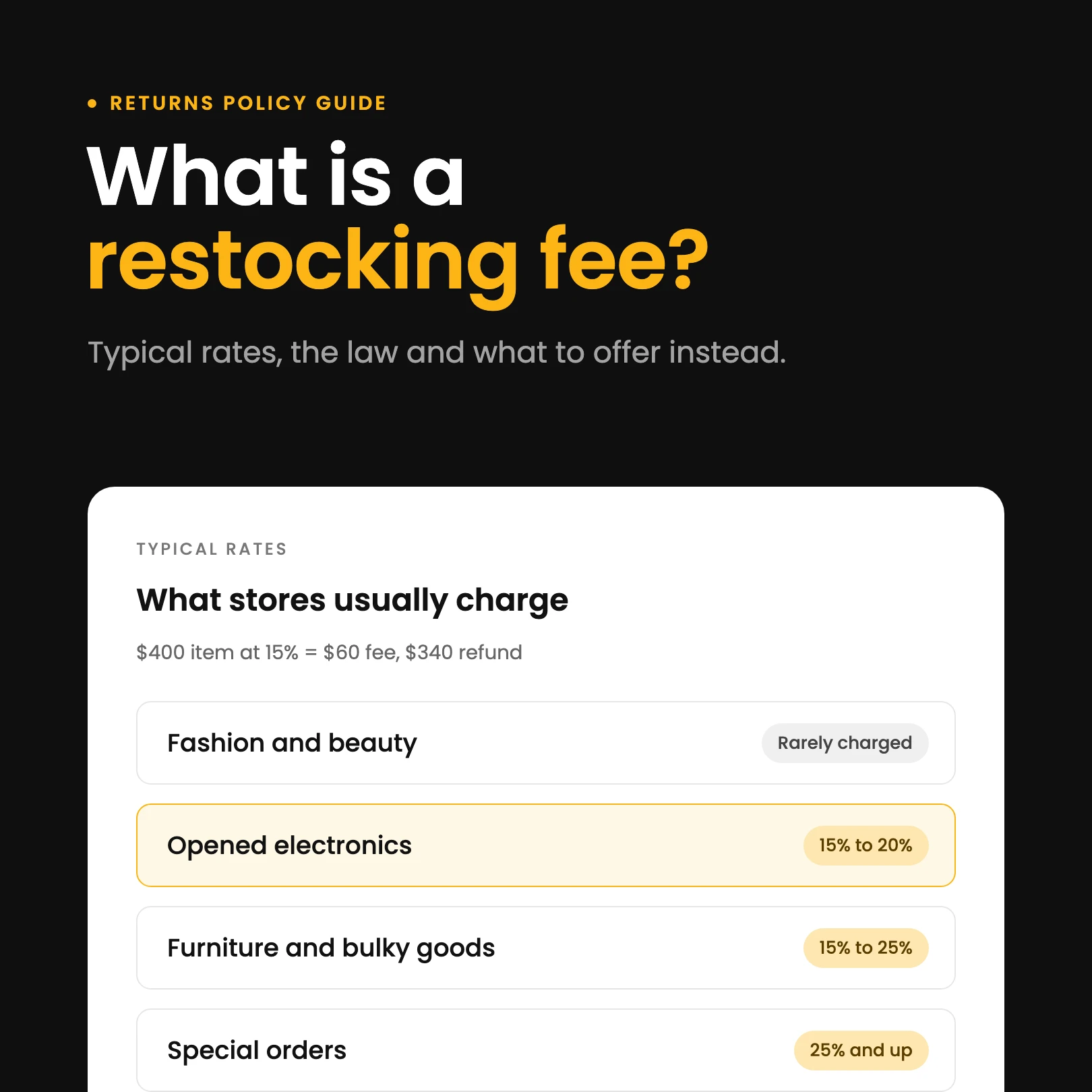
Restocking fees are most common where a returned product loses value or costs a lot to handle. Think opened electronics and appliances, furniture and other bulky goods, tools and equipment, special orders and anything made to measure. You see them far less in fashion and beauty, where most returns can go straight back on sale.
How to calculate a restocking fee
The maths is simple. Multiply the price of the returned item by your restocking fee percentage, and take the result off the refund.
Say a customer returns a $400 espresso machine and your policy has a 15% restocking fee. The fee is $60, and the customer gets $340 back. With a 20% fee on the same machine, the fee is $80 and the refund is $320.
Most stores work the fee out on the item price only, not on the original shipping or any tax. Whatever you do, say so in your policy, so a customer can work out their own refund before they send anything back.
What is a typical restocking fee percentage?
Most stores that charge a restocking fee set it somewhere between 10% and 25% of the item's price. 15% is a common middle ground, and 20% turns up a lot on electronics and large items.
Fees above 25% are rare and usually limited to things that are hard to resell, like special orders, custom furniture or items that have to be shipped back to a supplier. A 30% restocking fee on an everyday product will look high to most shoppers, and you'd need a good reason to defend it.
The percentage matters less than whether the fee matches what the return actually costs you. A 15% fee on an unopened item that goes straight back on the shelf is hard to explain. The same fee on an opened TV you'll have to sell as open box is easier to justify.
Why do stores charge restocking fees?
The main reason is cost. A return has to be received, inspected, repackaged and put back into stock, and someone pays for that time. Some items can't be sold as new once they've been opened, so the store takes a loss on resale as well.
The other reason is behaviour. A fee makes customers think twice before ordering something they're fairly sure they'll send back, and it puts some of the cost on the people who return the most. The trade-off is that shoppers read return terms before they buy, and a fee can lose you the sale altogether. We go through that trade-off in more detail in free returns vs return fees.
Are restocking fees legal?
In most cases, yes. In both the US and Australia a store can charge a restocking fee on a return the customer chose to make, as long as the fee was clear before they bought. Where stores get into trouble is a fee that wasn't disclosed, or a fee on an item that was faulty, damaged or not what the customer ordered.
This section is general information only and should not be considered legal advice. The rules differ between states and countries and can change, so talk to a lawyer before you change your returns policy.
Restocking fee laws in the US
No federal law bans restocking fees, and there isn't one national rule on what you can charge. The rules that do exist are mostly at state level, and they're about disclosure rather than the size of the fee.
A number of states require stores to display their refund policy where customers can see it before they buy. New York is one of the most specific. Its refund policy law says a posted policy has to state any fees, including a restocking fee, and the dollar or percentage amount of each one, and online stores can meet it with a notice near the item or a link the shopper sees before entering billing details. A store that doesn't follow the rules can be required to give a refund or credit on unused items for up to 30 days after purchase.
California's rule works in a similar way. If your policy is less generous than a full refund, credit or exchange within seven days, you have to post it, and a store that doesn't can be required to accept returns for a full refund within 30 days. Several other states have posting rules of their own.
If you sell into more than one state, the safest approach is to write your policy for the strictest one. Put the fee and its amount in your returns policy, on the product pages it applies to and in the order confirmation. A fee that a customer only learns about from their refund is also a common reason for chargebacks, whatever the law in their state says.
Faulty and incorrect items are a separate question. Charging a restocking fee to take back something that arrived broken, or that you sent by mistake, is very hard to defend and can run into warranty and consumer protection rules.
Restocking fees under Australian Consumer Law
Australian Consumer Law doesn't require you to accept change of mind returns. If you choose to accept them, you set the terms, and a restocking fee can be one of them. The fee has to be in your policy before the customer buys, and you have to apply it the way you said you would.
Faulty goods are different. If a product is faulty, unsafe, not as described or doesn't do what it should, the customer is entitled to a remedy under the consumer guarantees, and you can't charge a restocking fee, processing fee or return fee on that return. The ACCC has warned online stores whose return terms suggest otherwise, and it has specifically called out policies that apply restocking fees or return shipping charges to faulty items.
The wording of your policy matters here. A line like "a 15% restocking fee applies to all returns" can mislead customers about their rights, because it reads as though faulty items are included. "A 15% restocking fee applies to change of mind returns" says what you mean. Our guide to change of mind refund laws in Australia covers where that line sits, and faulty vs change of mind returns goes through what you owe a customer when an item is faulty.
When a restocking fee makes sense
A restocking fee is easiest to defend when the return really does cost you money beyond the shipping. That's usually the case when:
- the product loses value once it's opened, like electronics, appliances or software
- it's bulky or fragile and expensive to inspect and repack
- it was made or ordered specially for the customer
- it has to go back to a supplier who charges you for the return
It's much harder to justify on clothing, shoes, beauty and other products that are cheap to put back on sale, especially when the item comes back unopened. In those categories a fee tends to read as a penalty, and that's what ends up in reviews.
If you do charge one, think about where it applies. Plenty of stores waive it on unopened items, on exchanges or for repeat customers, and keep it for opened or used returns where the cost is real.
Alternatives to a restocking fee
Most retailers who look at a restocking fee are trying to protect margin on returns. There are other ways to do that which don't shrink the customer's refund.
Exchanges
An exchange keeps the sale. The customer gets the size or colour they wanted, and you don't hand any money back. Making exchanges free while keeping your normal terms on refunds gives customers a good reason to pick the option that costs you least. With Refundid's instant exchanges, the replacement can go out without waiting for the original item to arrive. If you sell on Shopify, we've written about how to handle exchanges on Shopify.
Store credit
Store credit keeps the money in your business and gives the customer a reason to come back. Some stores offer it for the full value while refunds carry a fee or a label deduction, which nudges customers towards credit without forcing it on anyone. In Refundid you can set up different return reasons with different options, so a change of mind return can offer store credit or an exchange while a faulty return still gets a refund. For Australian stores, our post on refund timeframes and store credit covers what the law says about credit notes and expiry.
Shopper-paid return cover with Checkout+
Instead of charging customers after they return something, you can let them pay for free returns when they buy. Checkout+ is Refundid's checkout option for Shopify stores. Shoppers can add free returns to their order for a small fee. If they later send something back, their return label is free and handling fees on other return methods are waived. Shoppers who skip it return on your normal terms.
Checkout+ is free for retailers, and you earn a share of what shoppers pay for it. Because it's a choice made at checkout, it doesn't feel like a penalty, and the customers who care most about free returns are the ones paying for them.
How to write a restocking fee into your returns policy
If you decide to charge a restocking fee, the policy wording does most of the work. A good restocking fee clause:
- says which returns it applies to, such as change of mind returns on opened items
- gives the amount as a percentage or a dollar figure
- says what it's calculated on, such as the item price excluding shipping
- makes clear it doesn't apply to faulty, damaged or incorrect items
- matches what customers see in your returns portal and order emails
For a full policy to start from, see our return and refund policy template for Australian stores, or how to write a Shopify return policy if you're on Shopify. If you want to see what other stores offer before you decide, we've also put together a benchmark of fashion brand return policies.
If you'd like to see how exchanges, store credit and Checkout+ would work on your store, book a demo.
Restocking fee FAQ
What is a 20% restocking fee?
It means the store keeps 20% of the item's price when you return it. On a $250 item, the fee is $50 and the refund is $200.
Is a 30% restocking fee too high?
For most products, yes. Most stores that charge a restocking fee set it between 10% and 25%. Fees of 30% or more are usually limited to special orders, custom items or products that can't be resold as new.
Can a store charge a restocking fee on a faulty item?
In Australia, no. A faulty item is covered by the consumer guarantees, and you can't charge a restocking fee or return fee on it. In the US it's very hard to defend, and it risks complaints and chargebacks even where no state rule covers it directly.
Is a restocking fee the same as a return fee?
Not quite. A restocking fee is usually a percentage of the item's price, so it grows with the value of the item. A return fee is a flat charge per return, whatever's being sent back. Both normally come out of the refund.
Should a restocking fee apply to exchanges?
Most stores don't charge one on exchanges. The sale is kept, and waiving the fee gives customers a reason to choose an exchange over a refund.
Can a restocking fee be waived?
That's up to the store. It's common to waive it for unopened items, exchanges, loyal customers or returns caused by a store mistake. If you waive it regularly, it's worth asking whether the fee is doing what you wanted it to.